In the startup world, MVP (Minimum Viable Product) has become like a religion. The theory sounds good: launch the product fast, check the market, and fix it later. However, in 2025, this strategy is often a trap.
“Move fast and break things” – this quote by Mark Zuckerberg ruled software development for the last ten years. The problem is, today’s market is full. If you “break things” when a user tries your app, you cannot fix them in the next update. The user will simply leave.
Why has the traditional MVP stopped working? And why at NextApps are we replacing it with the MFP model, supported by Productivity 3.0?

Author: Kasia
Imagine you are building a skyscraper. To save time, you decide to build the foundation out of wood instead of concrete. You think: “We will change it when the building reaches the 10th floor.”
Sounds crazy? This is exactly what happens in 80% of IT projects built as a “cheap MVP.”
Taking shortcuts—like skipping automated tests, hardcoding solutions, or ignoring architecture—creates technical debt. Like any debt, you have to pay interest on it.
When your app becomes a success, you suddenly face problems:
In the end, you face a tragic choice: spend a fortune fixing the mess, or rewrite the app from zero. As a result, a “cheap MVP” costs double.
Ten years ago, users forgave an ugly interface or small errors if the app solved their problem. Today, the standards are set by giants like Revolut, Uber, and Instagram.
Mobile research shows a “7-Second Rule.” This is how much time a new user gives you to make a first impression.
…the app gets deleted. In 7 seconds, the user does not judge the depth of features (“what the app does”). They judge the quality of interaction (“how it works”).
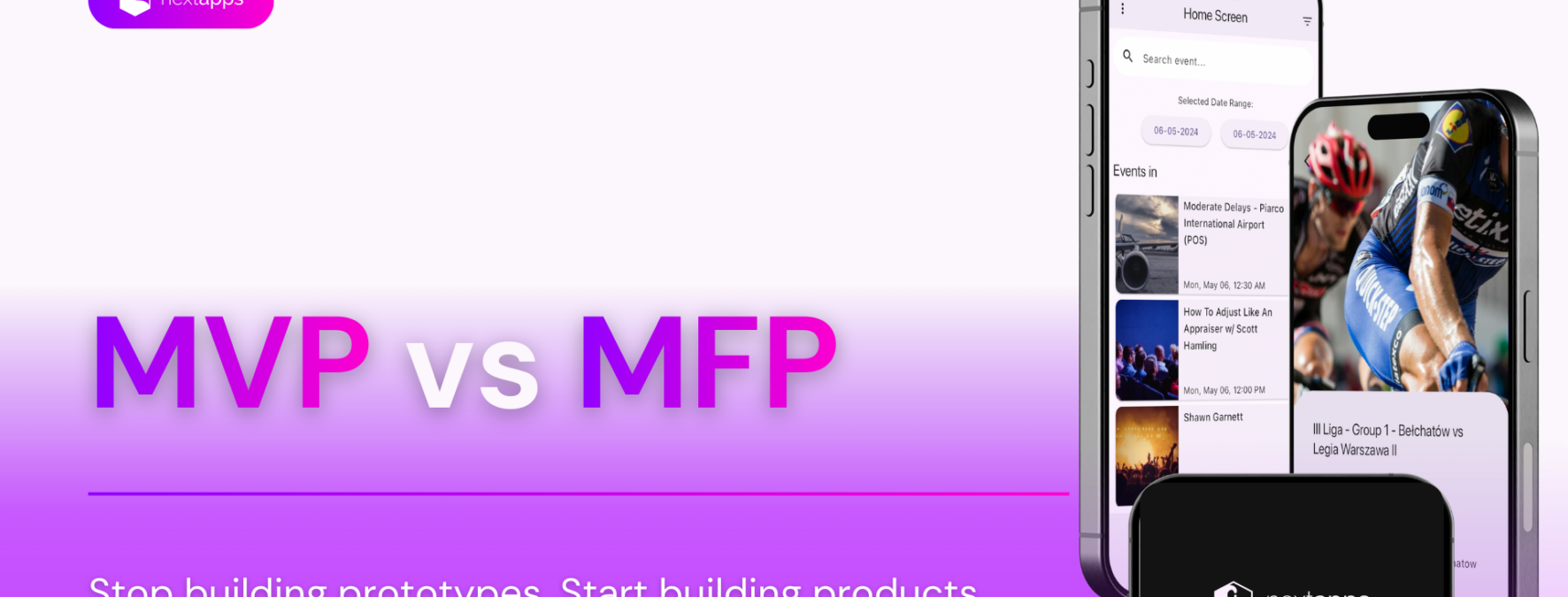
That is why at NextApps, we changed our goal. We do not aim for MVP. We aim for MFP – Minimum Feelable Product. This means a product that might have fewer features, but the ones it has work perfectly smooth, building trust immediately.
Here is the key business question: “If quality takes time, will building an MFP take too long?”
No. Instead of working harder, we changed our tools and processes to stop wasting time.

Most apps are 40-50% the same: login, forms, API connections, user profiles. At NextApps, we do not write them from scratch. We created FlutterPeak – our own library of ready-to-use, tested Low-Code components.
This lets us start the project from the “5th floor.” We don’t waste your budget on the basics. We invest it in what makes your product unique—business logic and perfect UX.

We use AI models (Claude 3.5 Sonnet) and automation tools (Bugbug.io) for tasks that are boring for humans:
This saves us 30% of engineering resources. We invest this time back into perfecting the details (MFP), which are usually ignored in the traditional model because “there is no time.”
Building a “cheap MVP” is fake savings. In 12 months, it becomes the most expensive part of your IT budget.
If you plan to launch a new mobile or web app, ask yourself: do you want to build a prototype you will have to throw away, or a scalable product that will survive?
At NextApps, we choose the second option. If you do too – let’s talk about your project.